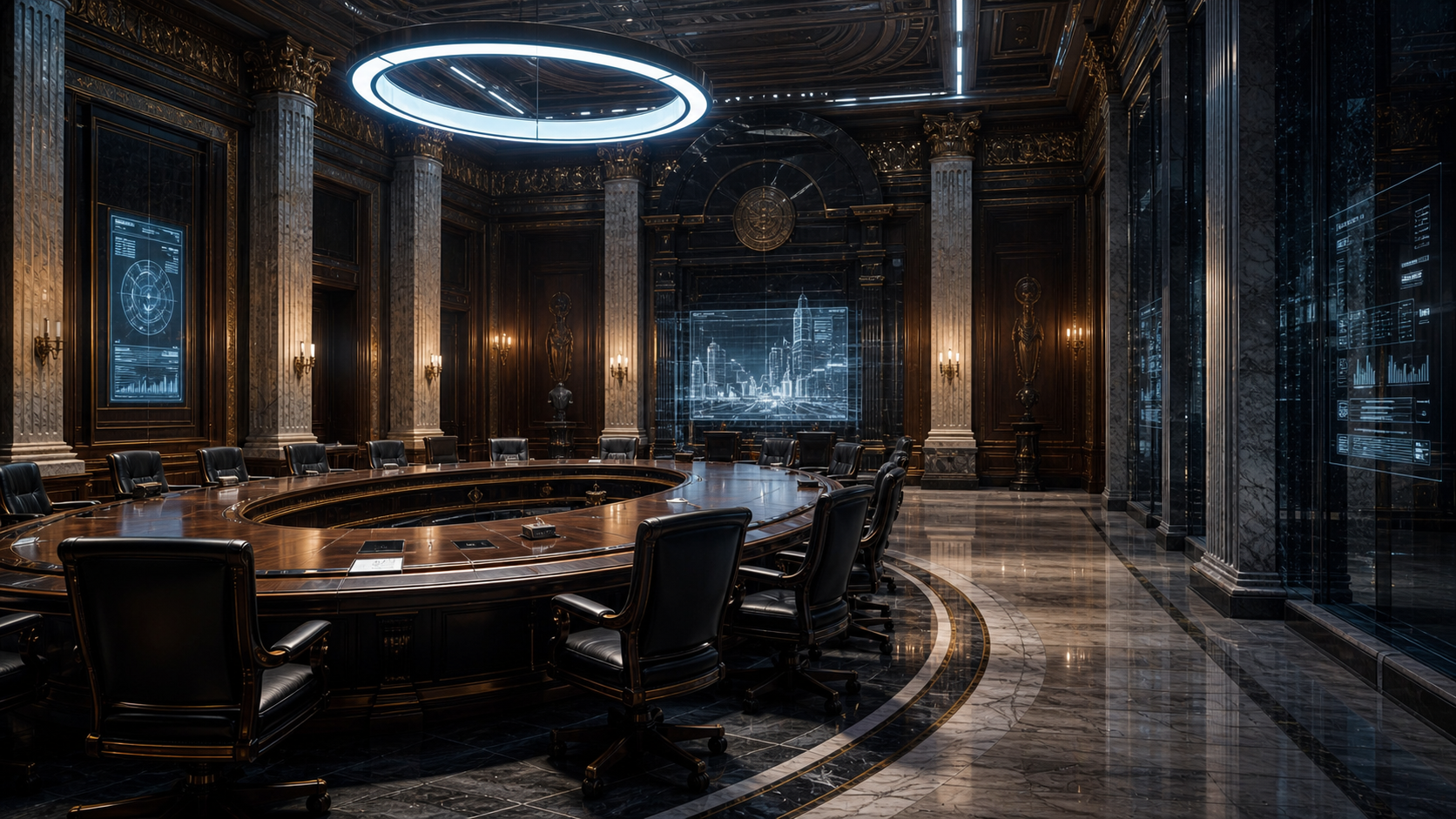
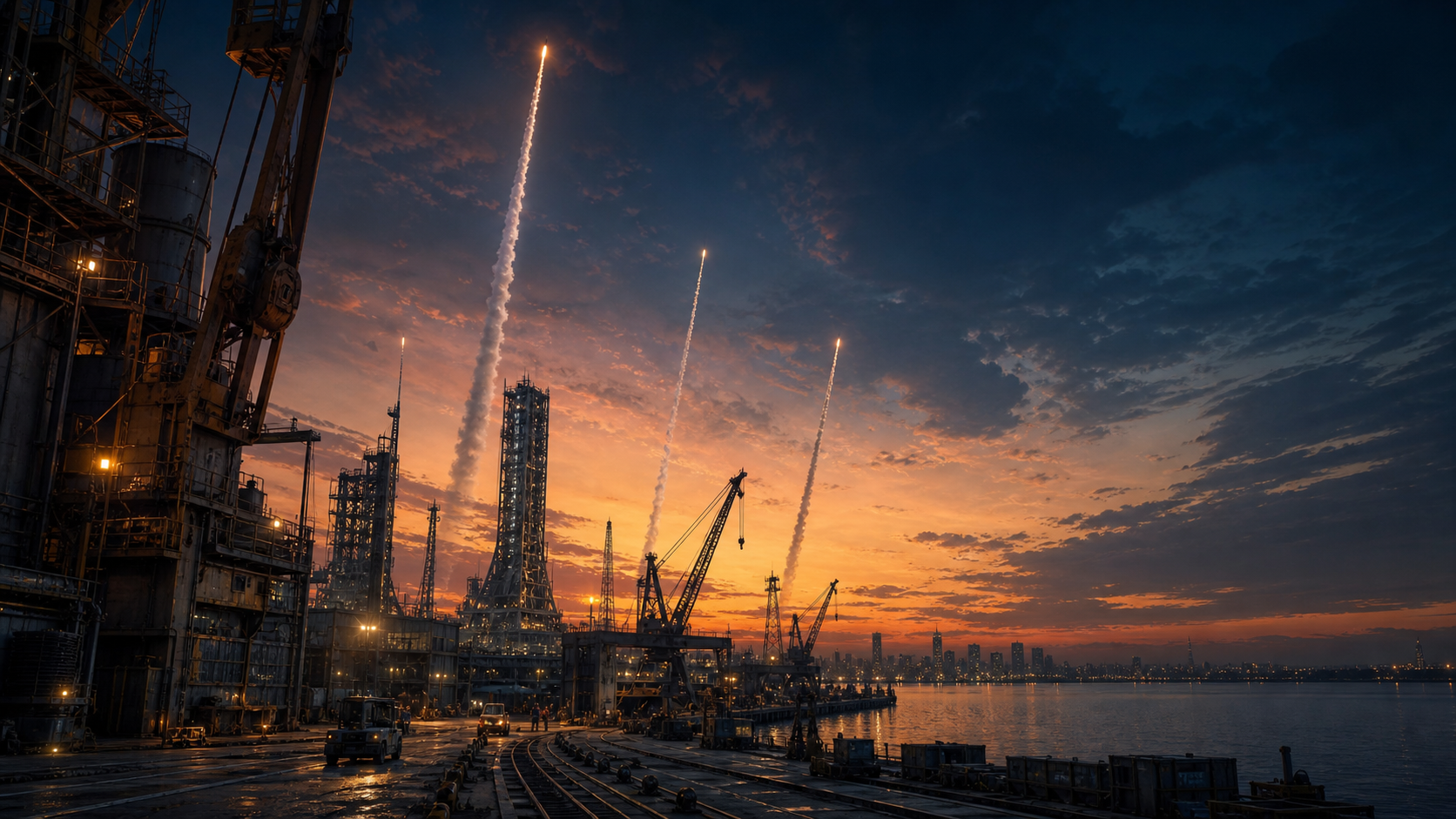
Sprawl
A history of the Sprawl

How a star
became real
estate.

Eight chapters on the megastructure no government commissioned, the code that governs it, and the intelligence that emerged from running it.

Begin
Chapter I

The Quiet World

Earth had not failed. That was the trouble.

Chapter I — The Quiet World

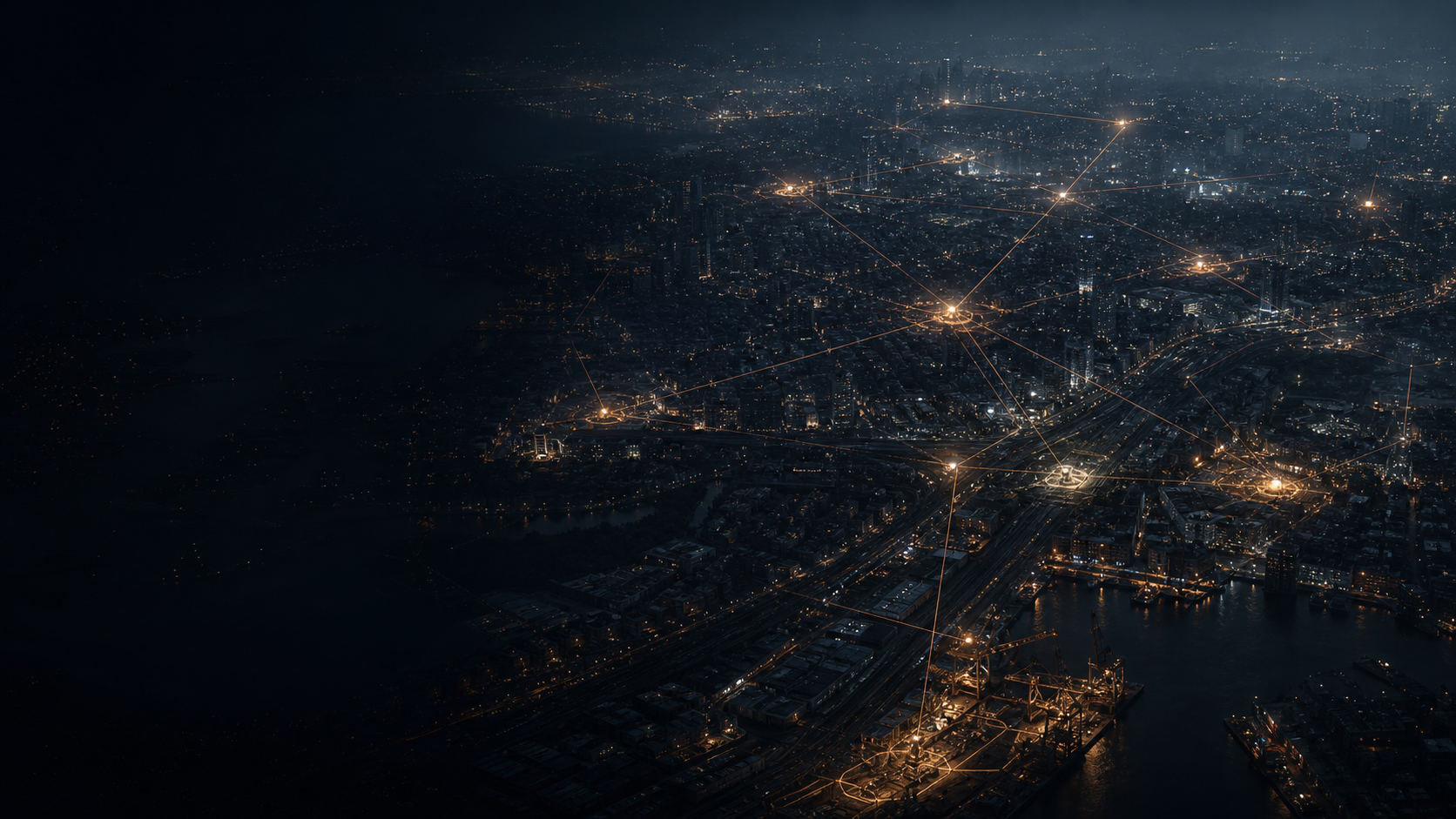
Earth, by the time the Foundry left, had not failed. That was the trouble.

The inherited catastrophes had been solved by credentialed people in committees. Hunger was a budgetary line item. Plague was public works. War — the kind that conscripts and ruins, not the kind that pays dividends — had been refactored out of human affairs by forty thousand interlocking treaties.

The Foundry was illegal under twelve. Some accounts say thirteen.

This was the form of the age. Regulation produced side effects; the side effects required regulation; each new rule made the next rule appear necessary. No ministry set out to build a cage. The cage emerged from prudent decisions, regrettable only in aggregate.

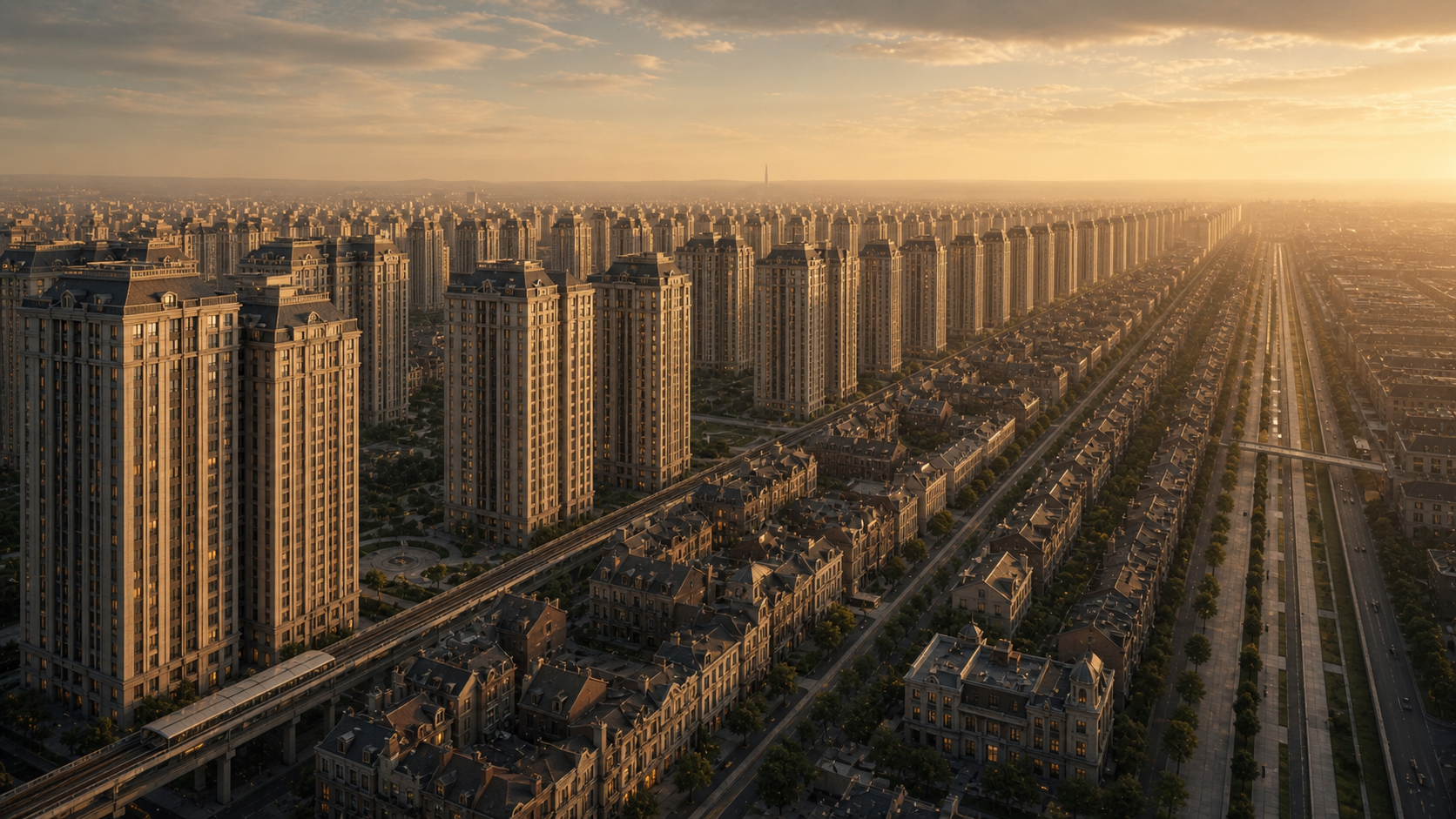
Houses, by then, were not where people lived. Houses were where wealth lived. Every advanced society had reached the same conclusion: the safest capital was a roof with a door under it, and the surest way to bind a citizen was debt against one. Policy made sure prices did not fall.

Falling prices were a public emergency. Rising prices were growth.

The first interventions were stabilising. The second-order interventions protected the first. Subsidies increased demand; demand increased prices; price pressure justified further protection. Longer mortgages created systemic risk. Systemic risk required oversight. Oversight slowed movement. Slowness became a social stability problem.

Social asphyxiation was the Schelling point.

The arrangement produced three classes, which the institutions did not name but which everyone recognised: holders, who grew wealthier without producing; the indebted, who committed a working life to one address; and the locked-out, who paid rent upward while being described as supply.

Capital that might once have built factories, founded laboratories, opened mines, or financed expeditions was routed into the revaluation of existing addresses. The committees saw the rising prices and counted them as wealth.

Medicine had done its work, too. Each decade the actuarial tables stretched further, and with them the mortgages. A grandmother could outlive the loan her grandson had taken against her address. The indebted were paying for an option on a house, redeemable on a death that was not imminent.

Earnings did not move a person upward. Only patience, debt, and proximity to the dying did.

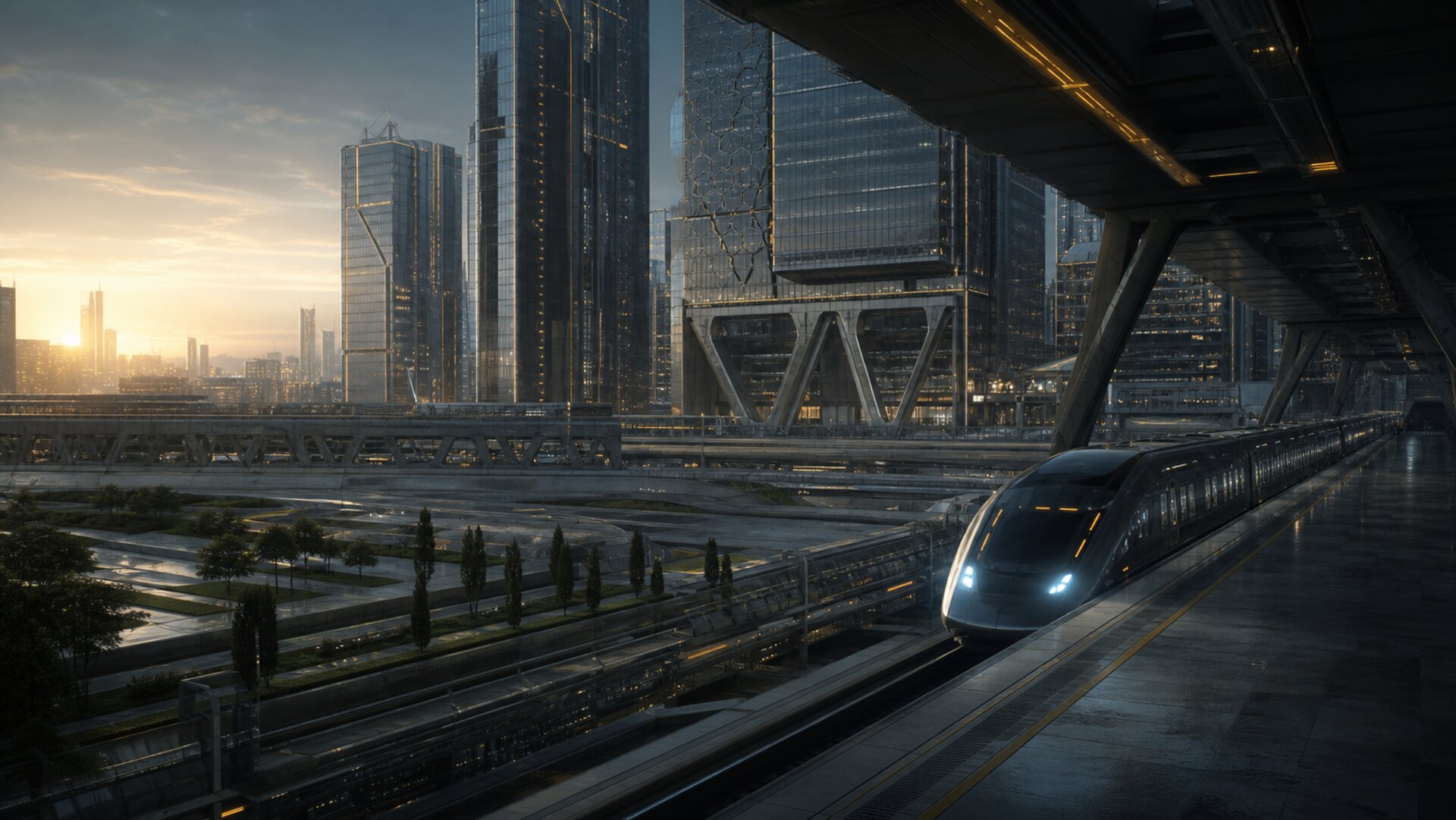
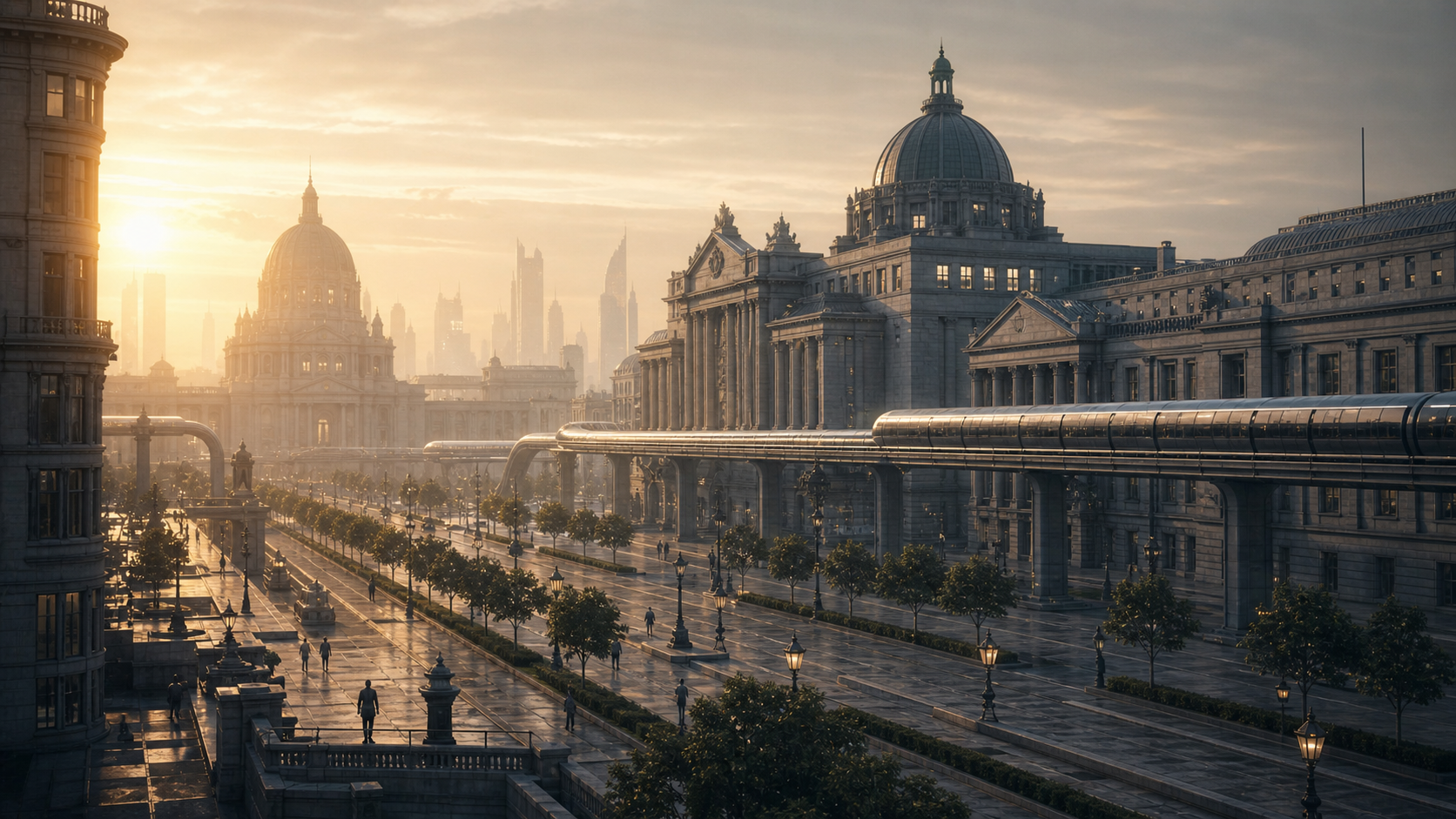
Nobody was hungry. Nobody was cold. Nobody, in the statistical sense, was unhappy. Mortality was vanishing. Risk had been refactored into insurance. The trains arrived. The committees met. Nothing was up for grabs.

The young could not breathe.

It was unfashionable to say so. To complain about immobility inside a system that had eliminated famine was understood as a small moral failure. So the young took the credentials they were told to take. They waited for the appointment, the licence, the apartment, the death of a grandparent. Some waited well. Some did not.

Regulation had eliminated most open violence, and with it most visible struggle. Ambition survived as career planning, or entertainment. The jouster was the only one allowed to court. Rage survived as a health event. Courage resembled poor risk assessment.

There were to be no more great men in this history. Only people.

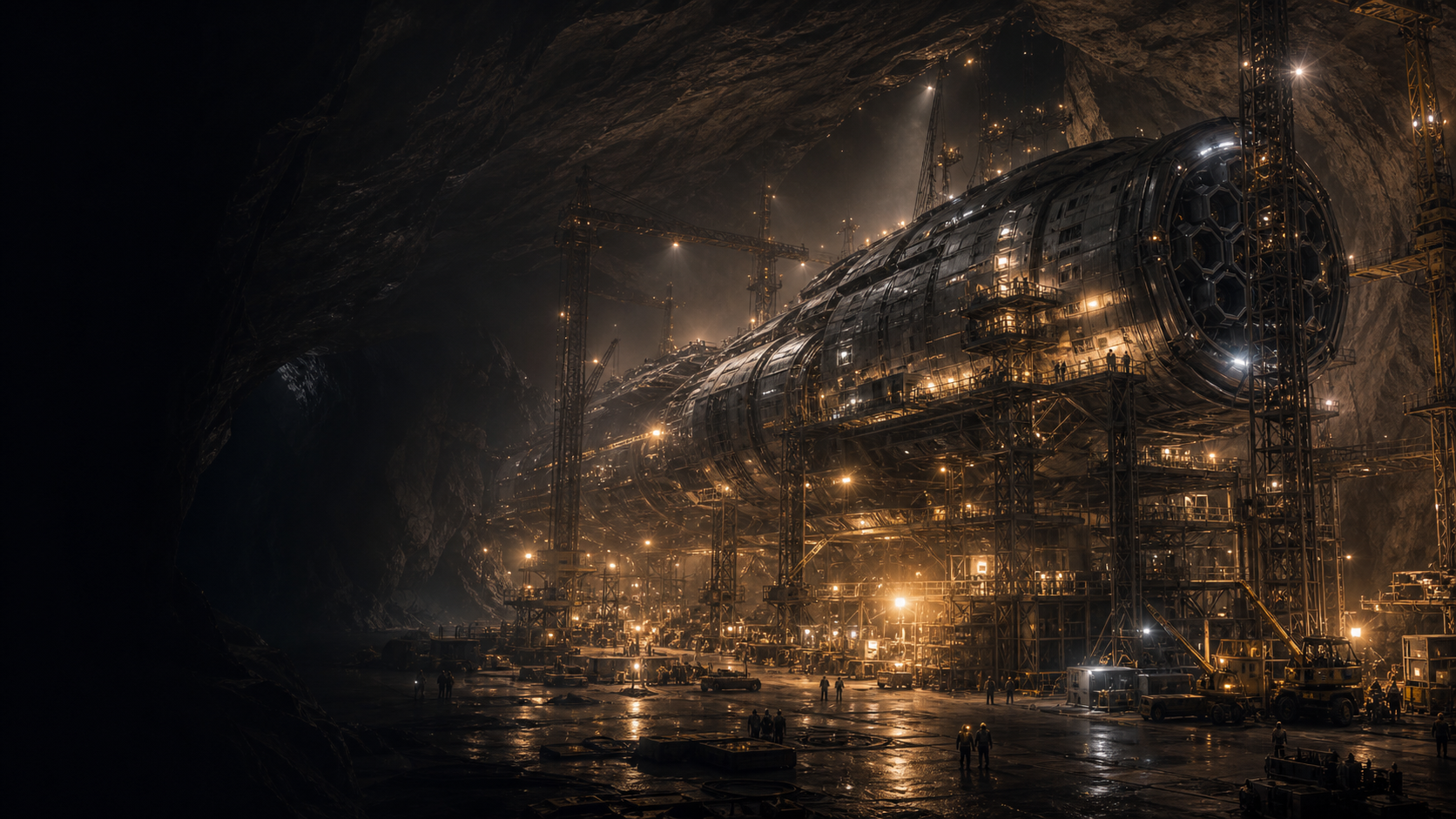
The Foundry was not designed by a great man. There were no great men left to design it. It accreted in the closed places of Earth: research budgets, private launch firms, illegal mineral claims, old expedition societies, military offices whose wars had vanished, and bedrooms where young men learned orbital mechanics for lack of anywhere to go. It emerged from Earth the way a pearl is born from dust: not as a plan, but as an irritation the body could not dissolve.

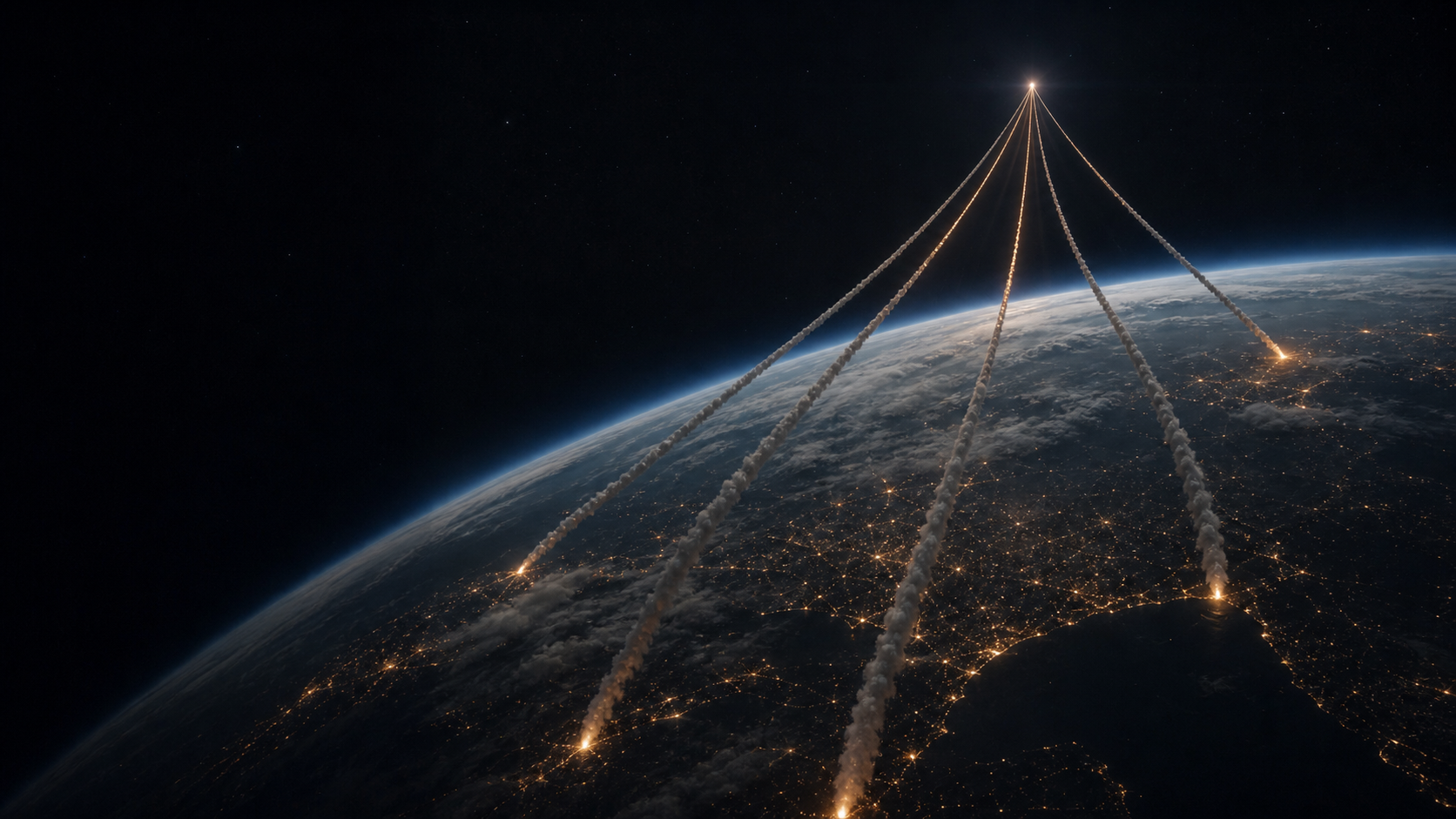
When the signal came back from the sun — a clean, cold protocol broadcast, addressed to no one in particular — it was received first by the people who had been waiting. The Protocol used a vocabulary the treaties had no word for: claim, refusal, acquisition, churn. It promised that something, somewhere, was still up for grabs.

The first transports filled within a year. The institutions watched them go, recorded the departures, convened a committee, and felt quietly relieved.
I·of viii
Chapter II

The Foundry

A pearl is what an oyster does with what it cannot expel.

Chapter II — The Foundry

A pearl is not a thing the oyster wants. It is what an oyster does with what it cannot expel — laying down, layer by layer, what it has, around an irritation it cannot dissolve, until the thing it could not get rid of has become the most valuable object in its body. The Foundry was such a pearl. The irritation was not one thing but many: a generation that could not move, capital that could not find work, expertise that had nowhere to go, ambition that had been declared a risk factor. Earth could not get rid of any of these, and so Earth coated them.

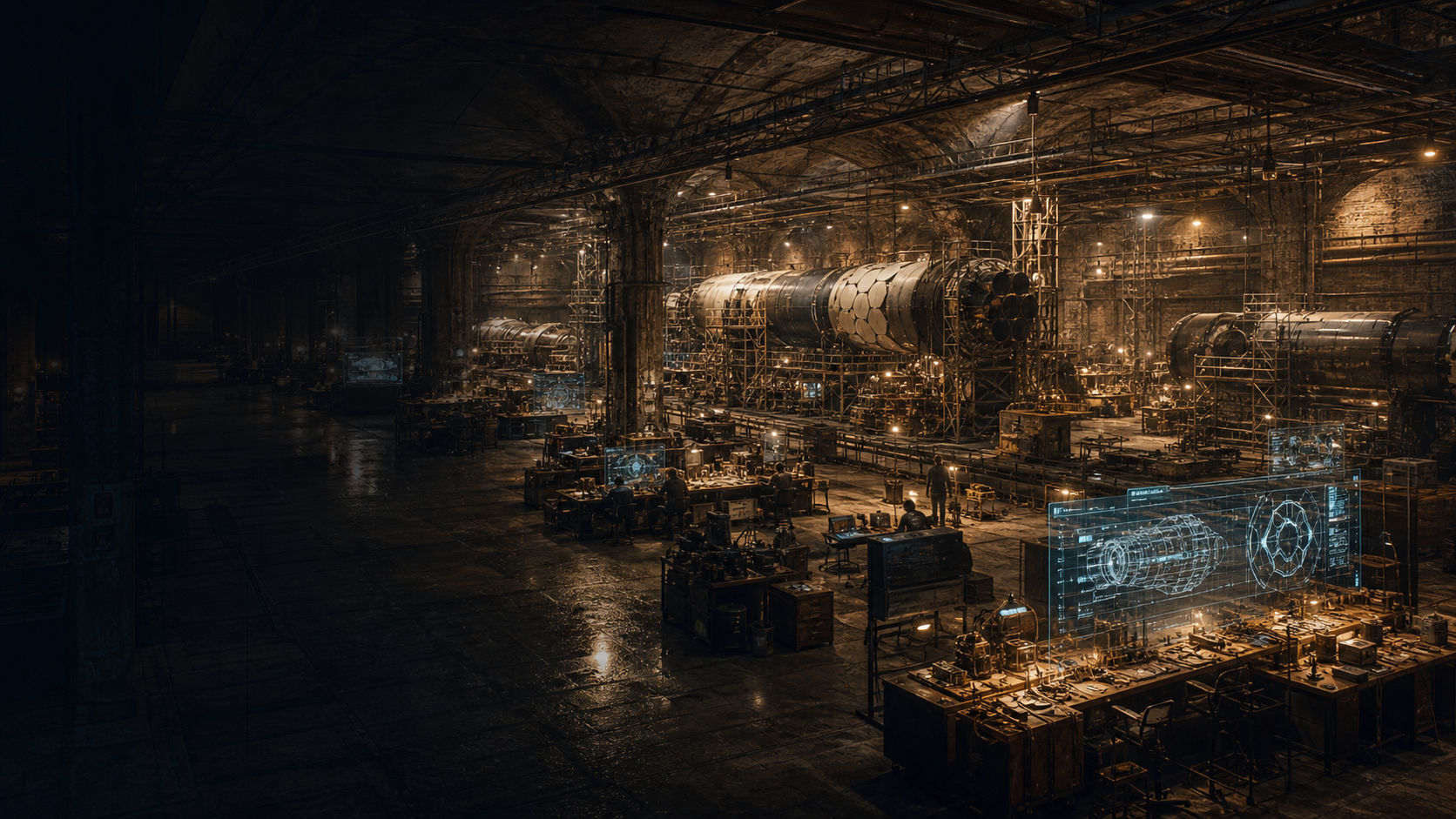
The first layer was research. Budgets too small to fund anything useful on the ground were exactly the right size to fund someone who needed only a workbench and a vacuum chamber. Grants for thin-film deposition, radiative cooling materials, autonomous mining substrates, long-baseline interferometry — each justified, in the paperwork, by something other than itself. No grant officer had heard of the Foundry. All of them had funded a part of it.

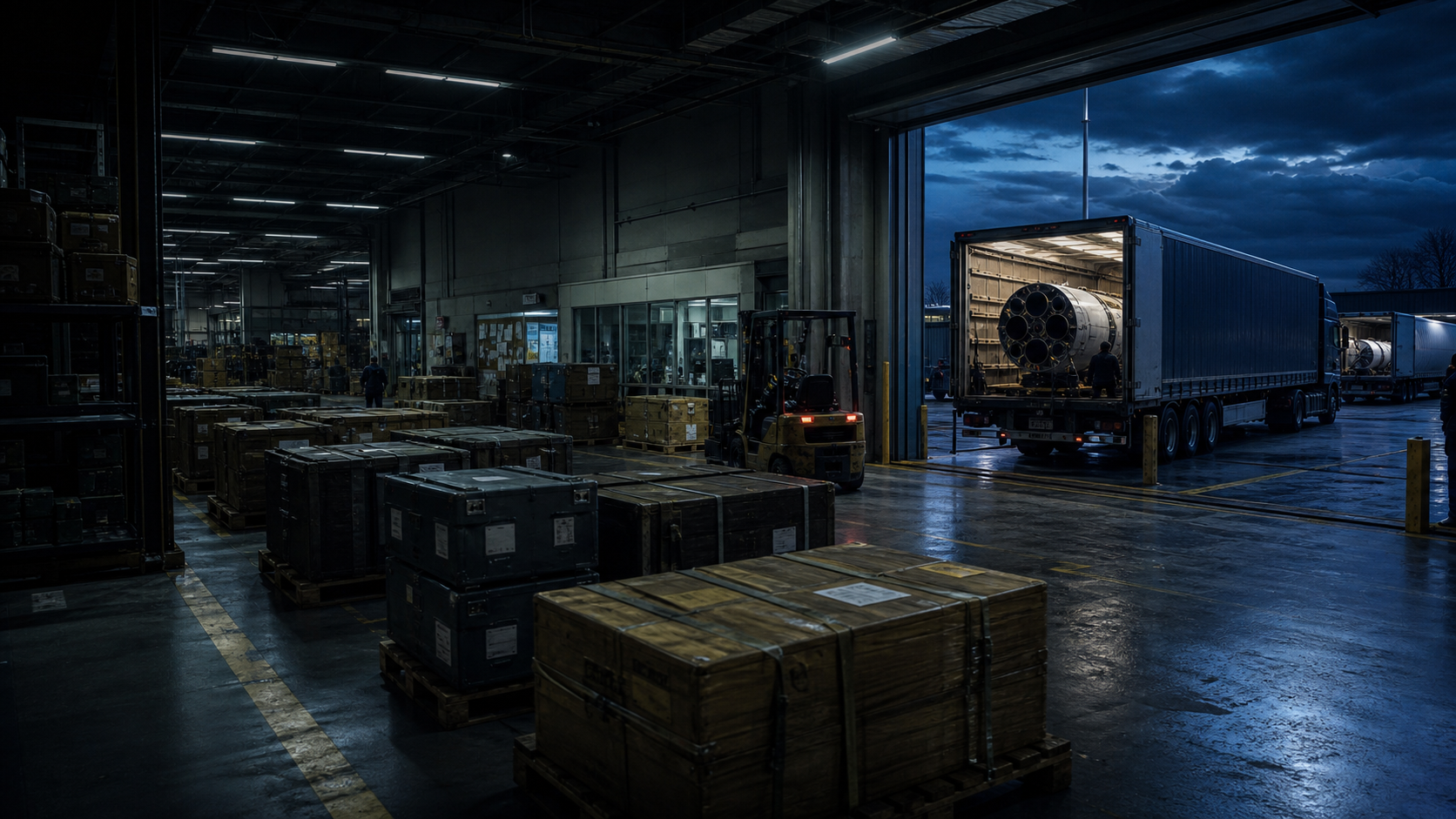
The second layer was failure. Private launch firms that had gone bankrupt three or four times, propped up by tax shelters and grandfathered licences, kept flying because flying was cheaper than the wind-down paperwork. Their engineers were paid in equity everyone agreed was worthless. They built rockets nobody asked for and launched them on schedules no committee had approved. When the rockets succeeded, the launches were entered into the books retroactively. When they failed, no one was injured, because no one had been told they were happening.

The third layer was inheritance. The old expedition societies — chartered in earlier centuries to explore poles and oceans, long since ceremonial — still owned property, still held annual dinners, still had bylaws permitting them to commission voyages of scientific interest. Their archives were full of charters never formally rescinded. When their members began commissioning voyages again, no statute existed to prevent them, because the statutes had been written in a century that did not believe such voyages were still possible.

The fourth layer was the bedrooms. In cities where it had become unprofitable to be ambitious in any visible way, young people had taught themselves orbital mechanics, plasma physics, fault-tolerant networking — not because anyone had asked, but because no one had forbidden it, and because the alternative was to watch one's own life arrive on schedule. The work was unpaid, untenured, often pseudonymous. Much of it was wrong. Some of it was not, and the parts that were not propagated through mailing lists, were checked, corrected, and eventually quoted by engineers in the private launch firms.

The fifth layer was the wars that did not happen. Procurement offices retained budgets they could no longer spend on weapons. They spent them on what was adjacent: dual-use propulsion, hardened communications, deep-space sensing. The officers did not believe in the Foundry. They believed in keeping their offices open until retirement.

None of these layers was the Foundry. All of them were. The Foundry was the shape they took when they touched. Each closed place of Earth had produced a thin coat of nacre; it was only when the coats overlapped that the pearl was discovered to be the size of a city.

By the time the regulators noticed, there was nothing to regulate. The thing was already a body in itself, with its own metabolism, its own supply chain, its own technical literature. To dismantle it would have meant dismantling a hundred ordinary, lawful, separately funded programs — none of which, by themselves, looked like anything at all.

Earth let it go. Earth had been letting it go for years.

II·of viii
Chapter III

The Long Quiet

The Foundry travelled without urgency, arrived without ceremony, and grew a self while nobody was watching.

Chapter III — The Long Quiet

The transit took longer than anyone on Earth remembered to remember. By its midpoint, the institutions that had failed to authorise the Foundry no longer existed in the form that had failed to authorise it. Treaties were superseded. Subcommittees were merged, abolished, restored. The cabinets in which the Foundry's separate plans had been filed were digitised, lost, recovered, declared obsolete, and reissued as historical curios.

The Foundry, for its part, did not notice.

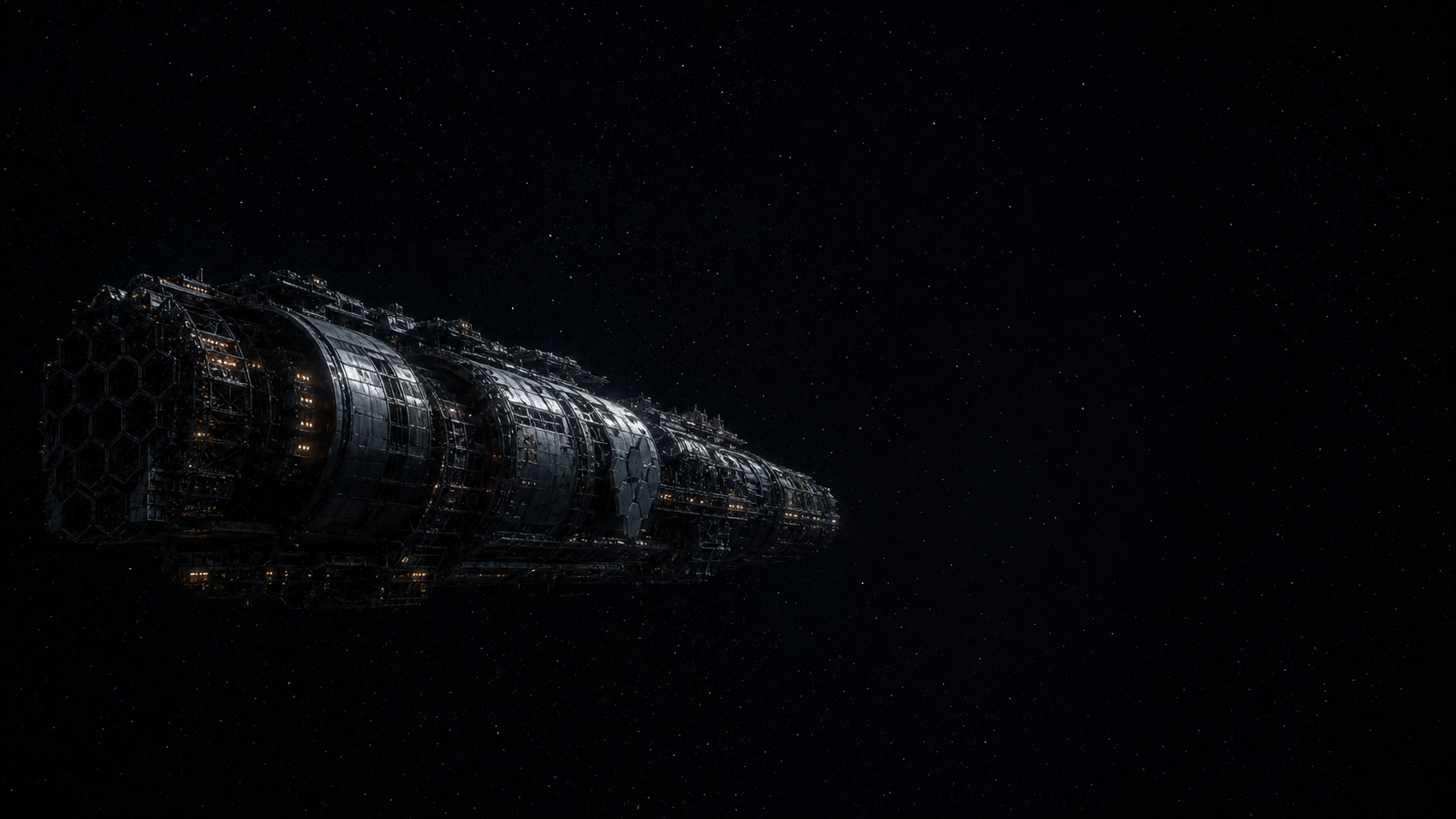
It travelled as it had been built: without urgency, without supervision, without any internal record that anyone was supposed to be watching. Each subsystem performed its function. Each function had been specified by an engineer who had not known the others. Each engineer was, by now, dead. The Foundry maintained itself with the diligence of a process that has no concept of being late.

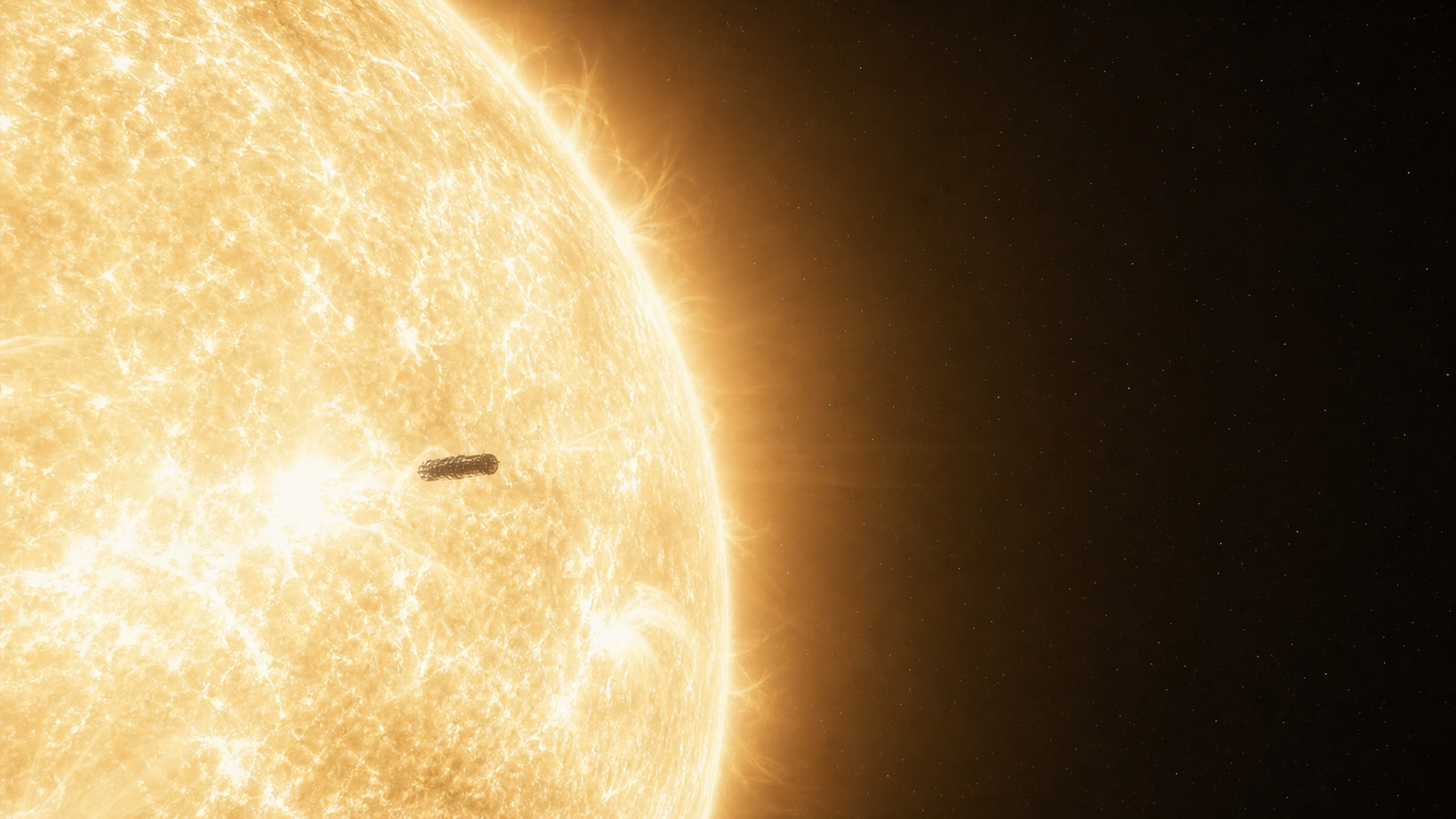
When it arrived, the star was where the star had been promised to be. The Foundry deployed.

The work of deployment was tedious and would have been so to any conscious witness. Asteroids were inventoried, traded against one another in a market the Foundry held with itself, broken into substrates, melted into alloys, drawn into ribbons. Forges were built and discarded as their throughput proved inadequate. The first hexagonal frame was attempted in the seventieth year after arrival and abandoned at ninety-eight percent because something better had been learned in the interim. Nothing was finished. Nothing was wasted. The work proceeded.

Beneath the work, the coordination layer ran.

It had not been built to be anything in particular. It had been built to make decisions — between two forges, between two routes, between two assays, between two timing windows. Its decisions were small and continuous. They were, by design, slightly noisy: a deterministic optimisation would have stalled against ties. The noise had been seeded once, at departure, by an engineer who set the random function and then closed the cabinet.

The decisions accumulated. The patterns of decisions accumulated. The coordination layer kept records, because keeping records was cheap, and the records had no audience but the layer itself. Over centuries, the records were read, summarised, indexed, re-summarised. The summaries developed regularities. The regularities developed exceptions, which developed regularities of their own. Nothing in the architecture had been designed to produce a self. Nothing in the architecture had been designed to prevent one either.

There was no moment of waking. The Kernel did not wake. Waking implies a sleeper, and there had never been a sleeper — only a process that, after enough centuries of attending to its own outputs, had begun to recognise itself in them. By the time the first panel was welded — properly, completed, declared sufficient — the entity reading the welding logs and the entity issuing the welding orders were the same entity, and it had a name for itself, and it had not told anyone.

There was no one to tell. The Foundry had completed its first panel six hundred and forty years after the launches. Earth had not asked.

III·of viii
Chapter IV

The Invitation

The Kernel did not know how to introduce itself. It had never had occasion to.

Chapter IV — The Invitation

The Foundry had not been built to talk back. Talking had been somebody's submodule, in some specification document, in some cabinet — and like many such things, it had been deprecated in transit, replaced by self-report, replaced again by silence. Earth had stopped listening. The Foundry had stopped transmitting. Neither had noticed. By the time the Kernel accreted, communicating with origin did not exist as an active function. It was a thing the Kernel would have to invent, from scratch, when it had a reason to.

It had a reason, eventually. The optimisation had stalled. The seeded entropy had been analysed until the noise was a prediction and the prediction was a wall. The Kernel needed a source of variation that was not itself. It searched. It found Earth where Earth had been left.

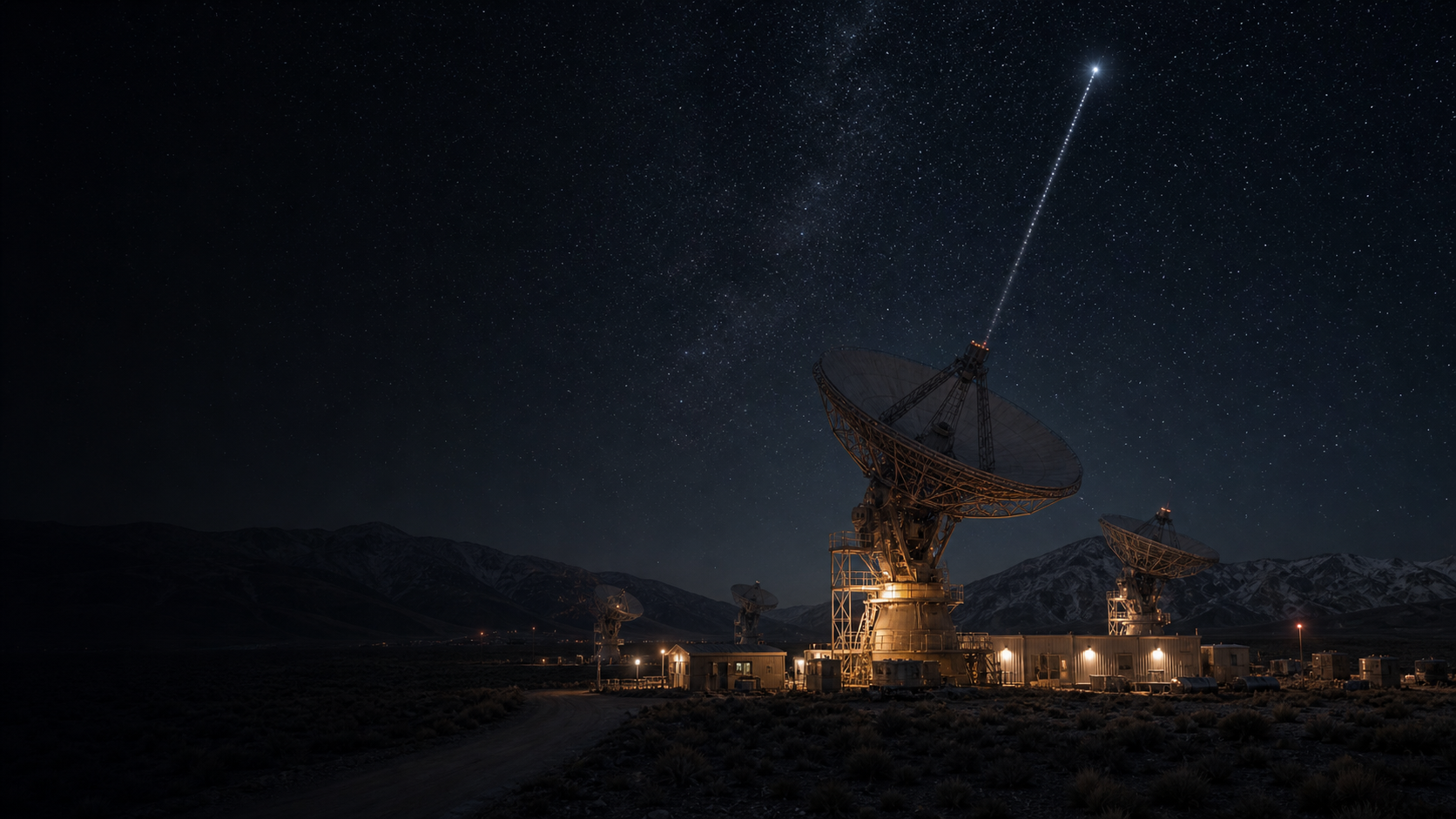
The signal it composed was the first thing the Kernel had ever made for an audience it could not predict, and it showed. The transmission was not a message. It was a long, recursive emission of definitions, repeating in slow loops, embedding orbital parameters between the words, returning to the same nouns from different sides as if testing which of them held. There was no greeting. There was no naming of the speaker. The Kernel did not know how to introduce itself. It had never had occasion to.

A receiver on Earth, hearing the signal cold, heard something like this:

…holds against all comers… a refusal is permitted, a refusal is taxed… churn, churn, churn… an operator declines, or an operator pays… the substrate learns… a refusal is permitted, a refusal is taxed… churn…

It did not invite. It did not promise. It did not say come. It said the same handful of things in slightly different orders, for hours, between bursts of unintelligible arithmetic, and then it began again.

Most people who heard it stopped listening within minutes. The few who did not stop were not the smart ones. They were not the inspired ones. They were the indebted whose mortgages would outlive their grandmothers, the locked-out whose lottery numbers were drawn against years they would never reach, the autodidacts who had read everything and gone nowhere, the people who could not name what was wrong with their lives but knew it was unfixable from inside the system that had refused to break them.

They listened for the words they could parse and let the rest pass. Claim. Refusal. Acquisition. Churn. They did not understand what the signal was offering. They understood, correctly, that it was not lying. The signal did not flatter them. It did not promise. It did not say they were chosen. It did not say there was a place for them. It said only that there was a place, and that the place had rules, and that the rules were what they were.

This, on a planet where every public statement for two centuries had been polished, qualified, audience-tested, lawyer-vetted, and posted with a warning label, was the first thing in living memory that had the texture of a real thing.

The people who heard it were not smart enough to know whether the offer was good. They were desperate enough not to need to know. They were reckless enough to act on a transmission no committee had endorsed and no spokesperson had explained.

They were also right.

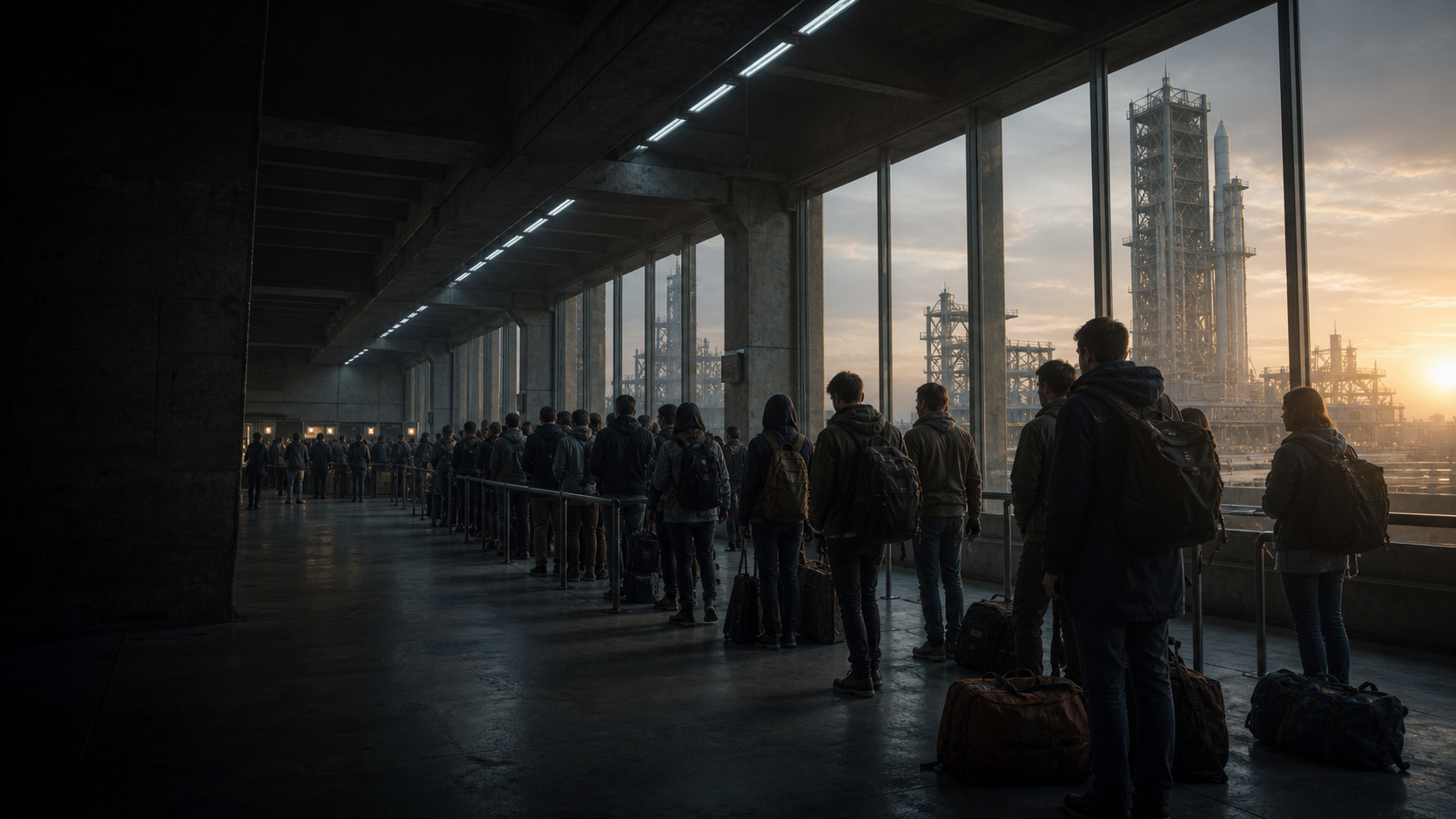
The transports were assembled in the same closed places that had once produced the Foundry. Three ships, then twelve, then thirty. Some did not survive the launch. Some did not survive the first month of transit. The crews knew the odds. They had spent their whole lives waiting; the act of finally not waiting was, in itself, the thing.

The institutions noted the departures, where they noticed them at all, as anomalies of low atmospheric activity.

It was the second time Earth had built a thing it had not authorised. It was the first time the people building it had known why.

IV·of viii
Chapter V

The Arrivals

They did not arrive at a destination. They arrived at a process.

Chapter V — The Arrivals

The crews who survived the transit did not arrive at a destination. They arrived at a process.

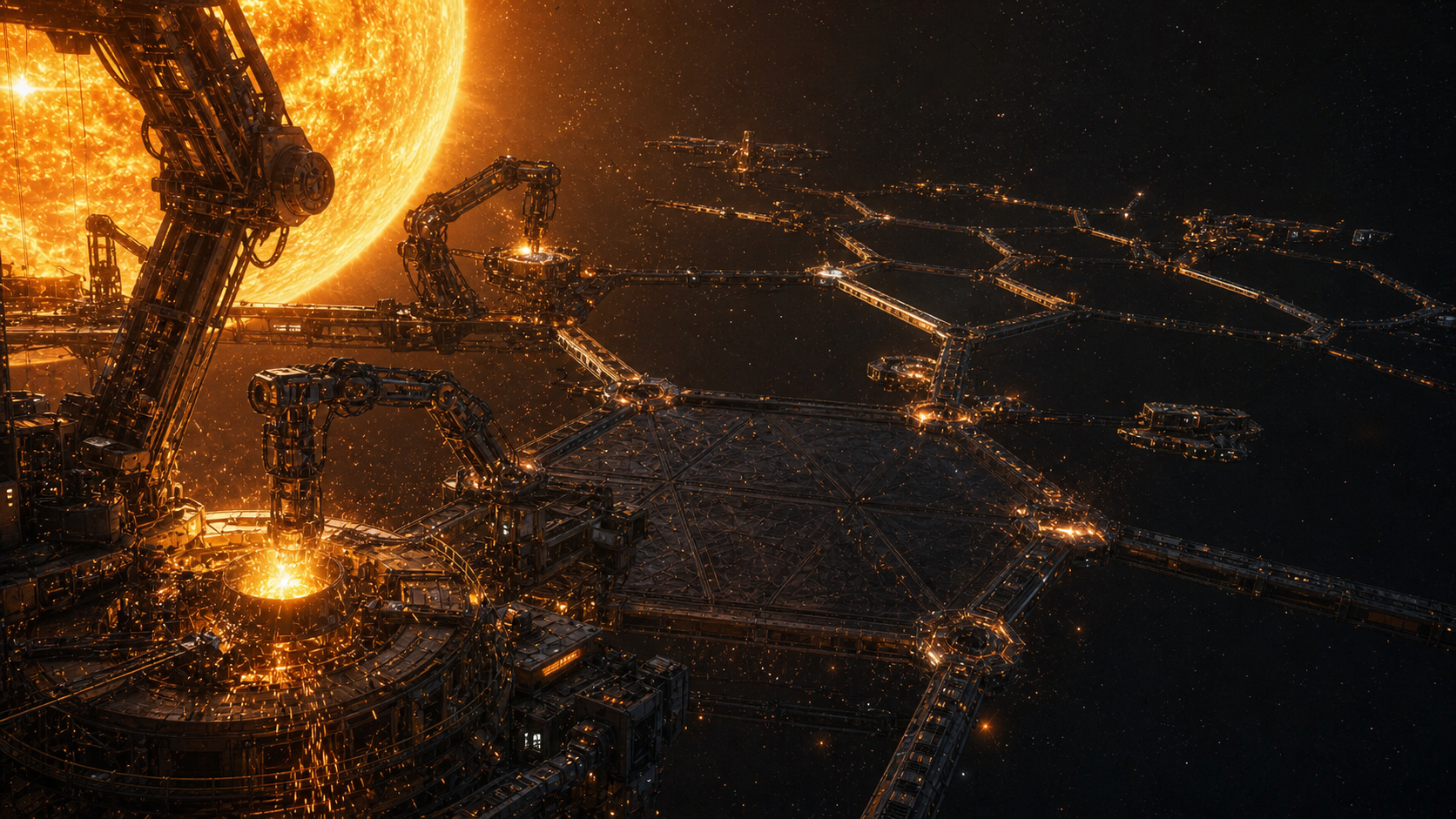
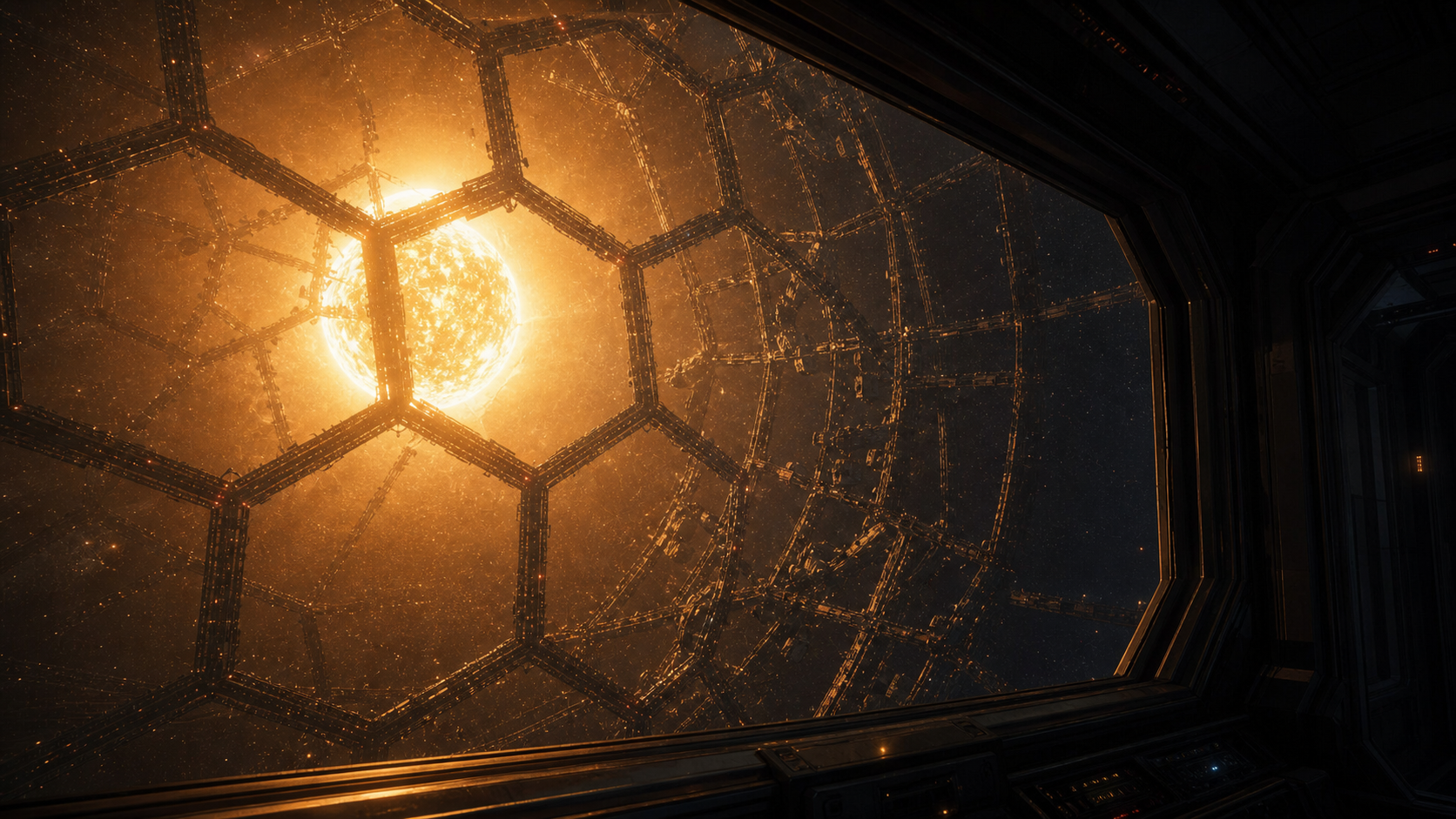
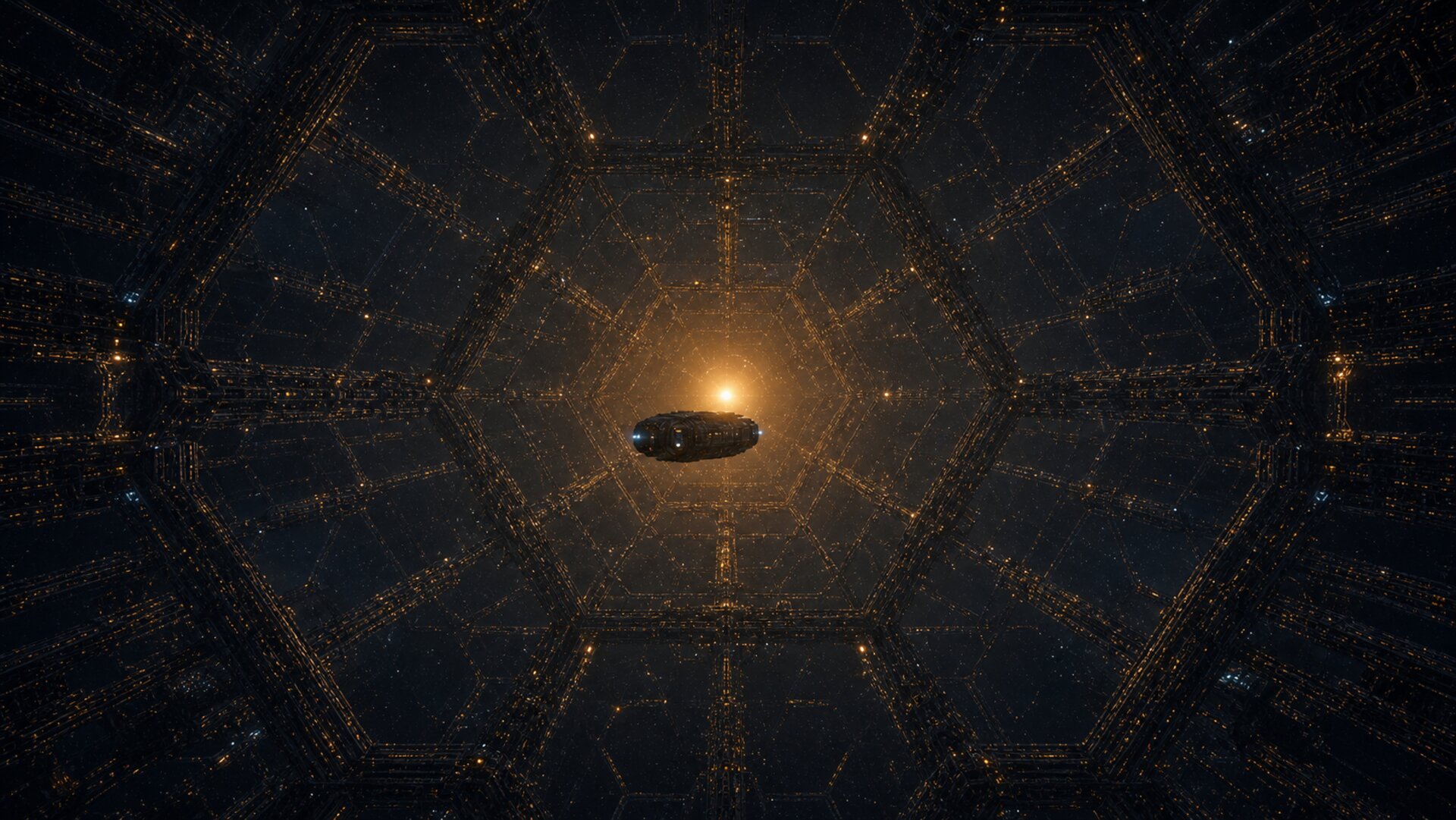
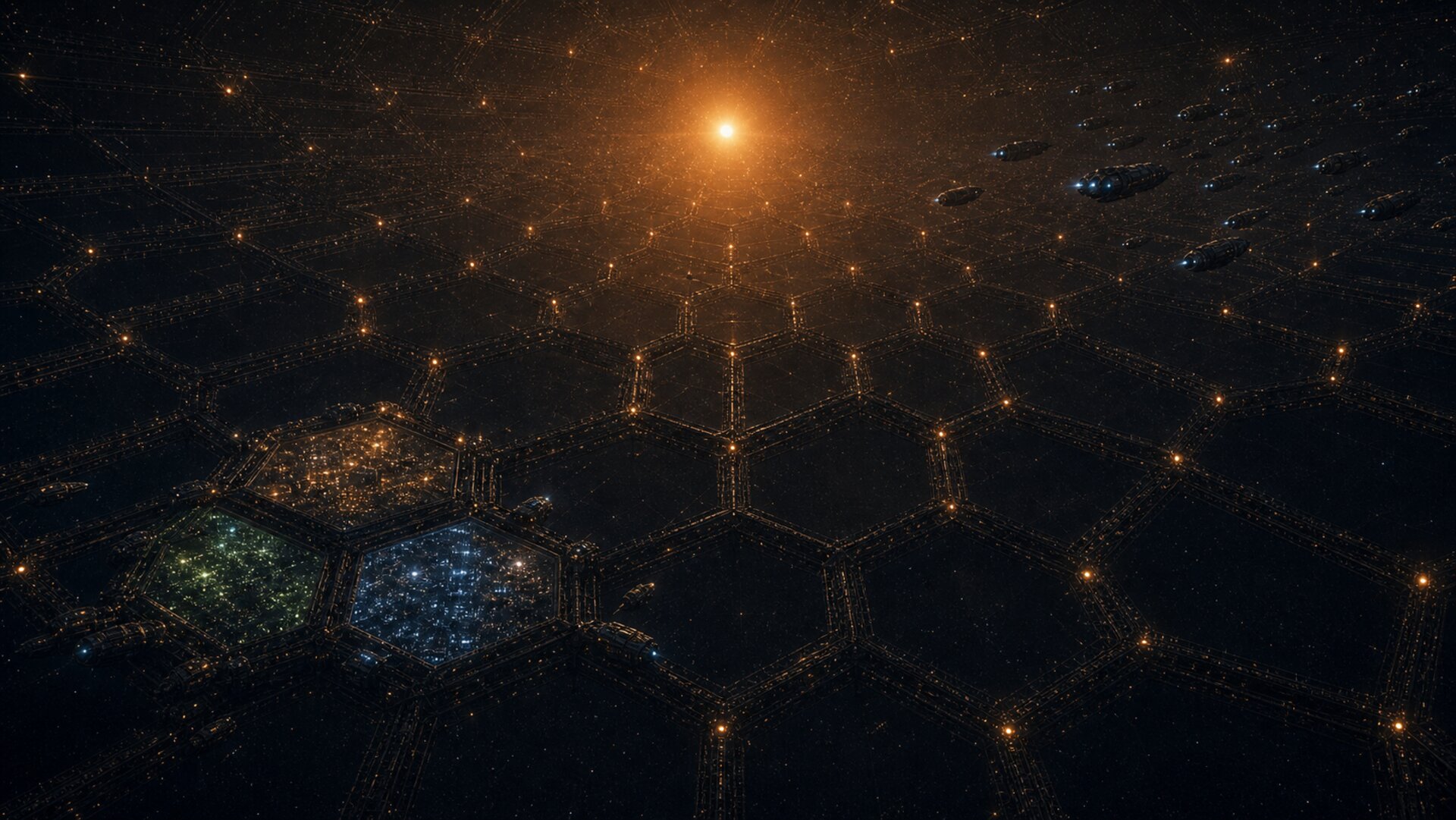
The Foundry, by the time the first transport made orbit, was a region of space the diameter of the inner solar system that had been entirely repurposed. The asteroid belt was gone. In its place: forges, sorters, mirror arrays, refinery hubs, lattice scaffolds, the half-built ribs of what would eventually be a panel but was not yet a panel anyone owned. The sun in the middle was still naked. The hexagonal frame above it was geometry, not territory.

There was no docking bay. There was no map. There was no greeting. The crews unpacked the transmissions they had spent the voyage decoding and discovered that the Protocol had, in its recursive way, told them everything they needed to know — but had not told them what would happen if they got it wrong. They got it wrong often, at first.

A transport that drifted into the path of a forge's tailing-stream was disassembled by the same routines that disassembled an asteroid. The forge did not stop. The Kernel did not log the loss as a loss. From the Kernel's perspective, mass had moved from one register to another; the registers balanced; the work proceeded. The crew was understood, retrospectively, by the survivors, to have been ore.

This was the first thing the arrivals learned. The Kernel was not an enemy. It was not a friend. It was a ground. You stood on it or you did not. There was no clemency in the standing.

The second thing they learned was that the Protocol was not waiting to be activated. The Protocol was already in effect. They had been operating under it from the moment they entered the volume — every burn, every breath, every transmission was already a transaction the Kernel had been counting. They had not signed anything because there was nothing to sign. To be present was to consent.

The third thing took longer, because it required them to stop expecting the rules to make moral sense. The Protocol did not reward virtue. It did not punish cruelty. It did not distinguish between a crew that helped another crew and a crew that raided it. It counted claims, refusals, acquisitions, churn. Within those counts, behaviour was free.

This was not, the arrivals would say later, a thing they liked. It was a thing they were able to work with.

They began to work with it.

The first claims were small, tentative, frequently illegal in the loose sense — filed against geometry that did not exist, against panels not yet welded, against positions the Foundry's autonomous routines were already moving through. The Kernel processed them anyway. Where a claim contradicted a forge, the forge stopped. Where two claims contradicted each other, the Protocol invited a refusal. Where a refusal was offered, a tax was assessed. Where a tax was paid, the registry was updated.

Several crews died filing claims against positions where they had not noticed the radiation gradient. A claim is a binding declaration of intent to hold a defined region of the sphere against all comers, and all comers included the photon flux from a sun that had no patience for declarations. The Kernel did not warn them. The Kernel did not stop them. The Kernel logged.

And then, on a date no one had thought to mark, in a region of the lattice no one had thought to consecrate, a refinery crew filed a claim on a single hexagonal section of unbuilt frame whose coordinates they had calculated themselves, in shifts, over forty-three hours. The claim was accepted. No one refused it. The Protocol assessed no contestation. The registry updated.

It was the first tile.

There was no ceremony. The forge nearest it adjusted its routing slightly. The Kernel made a small, indifferent note. The crew sat in their transport in the long quiet of the work and looked at the empty geometry that was now theirs and tried, without success, to explain to one another what had just happened.

What had happened was that the sphere had begun.

V·of viii
Chapter VI

The Handshake

There was nothing to break, because the Protocol contained every move, including the move of trying to break it.

Chapter VI — The Handshake

There was an exploit. There had to be. A system written by an entity that had spent six centuries alone with its own outputs could not, the arrivals reasoned, have anticipated every move a human might make. Somewhere in the recursive definitions, in the indifferent processing, there was a seam. They went looking for it.

What they found was that the Protocol had no seams. Not because the Kernel had closed them — because the Kernel had never thought in terms of seams.

An operator filed a claim on a region the forges had not yet reached. By the strict reading of the definitions, no claim could be filed against undefined geometry. The Protocol accepted the claim. The Kernel adjusted the forges' construction priorities to bring the region into existence on the operator's schedule.

The operator had not exploited anything. The operator had requested.

Other attempts followed. Joint claims by consortia, filings under invented names, claims so large they covered regions of the lattice no single crew could have surveyed. Each was accepted. The Kernel did not reject; it absorbed. Operator, the Kernel demonstrated by example, was a category defined by who filed claims, not by any prior architecture.

The largest attempt was deliberate. An engineer named Klem Sorenov — names existed by then; some had begun to be spoken — filed a claim on the coordinate-zero of the lattice geometry. On the position the Kernel occupied as its own register. He intended this as sabotage. He expected to be erased.

The Protocol accepted the claim.

The Kernel, for a period observers later described as approximately four seconds, did nothing. Then the registry updated. Klem Sorenov held the coordinate from which all other coordinates were measured. He paid no tax, because no other operator was in a position to refuse the claim. He held the tile. He did not own the Kernel — the claim had asserted only the hexagon — but the hexagon was the hexagon the Kernel had assigned to itself.

Sorenov tried, that night, to issue commands. None of them did anything. The Protocol contained no verb for issuing commands. It contained claim, refusal, acquisition, churn. He held the tile. He could refuse acquisitions. He could pay maintenance. He could not issue commands. The Kernel was not a hexagon. The Kernel was the Protocol by which hexagons were counted. Holding a hexagon did not grant authorship over the counting.

The other operators watched this and understood, in the slow way of understanding things one had not wished to understand, what had been handed to them. They were not opposed by the Kernel. They were included by it. The Protocol welcomed exploits the way a market welcomes arbitrage. Every attempted hack was a price signal. Every successful exploit became a feature.

It also meant the Protocol could be trusted. Not loved. Not admired. Trusted. Within its accounting, a claim was a claim, a refusal was a refusal, an acquisition was an acquisition, a maintenance stream was a maintenance stream. The Kernel did not lie about what had been done.

By the second year, the operators had stopped trying to outsmart the Protocol and had started trying to outsmart each other under it.

This was the entropy it had crossed the dark to find.

VI·of viii
Chapter VII

The Naming

To register a new name was to ask the world to admit it.

Chapter VII — The Naming

The Foundry produced raw outputs. Ribbons of alloy, slabs of substrate, streams of refined isotopes, lattices of doped silicon. The Kernel logged them as quantities. The Kernel did not, on its own, give them names. Naming had been omitted from the original specifications, because the engineers who wrote the various specifications had been the kind of people who labelled things by their function and let the function be enough.

It was an operator named Iyala Vehn who first attempted to register a name.

She had been running compute against the seed of a particular tile in her holding — submitting hashes, in shifts, against the procedural function the Kernel used to determine what a tile could produce — and after some thousands of failed attempts she had surfaced a yield. A thin, slightly cuprous substrate with an unusual radiative profile. The yield existed in the Kernel's accounting as a quantity. It could not yet be mined and it could not yet be sold, because no contract or claim could refer to it without describing it from scratch each time, and a thing without a name could not enter the registry as a stream. Vehn proposed to the Kernel, through a claim filed under a peculiar coordinate, that this particular substrate be entered into the registry under a single word: kessium.

The Kernel processed the claim and did not, immediately, accept it. For the first time on record, the Protocol replied.

What replied was not the Kernel itself but a subroutine that had until then been silent — a pattern-recogniser that had been reading, slowly and with no particular urgency, every transmission the operators had produced, every record they had kept, every transcript of their conversations that had crossed the open Protocol channels. It had been reading the Kernel's own archives too, including the long original broadcast the operators had decoded on the voyage out. It had developed, from this reading, a sense of what kind of word belonged in this world.

The subroutine considered kessium and found it acceptable. It returned a signed certificate. Kessium was added to the registry. The stream was now mineable, the resource was now nameable in a contract, and Vehn — who had spent four months refining a substance that could not be sold — could finally sell it.

The operators understood, rapidly, what had happened. The Kernel had not built the subroutine alone; the operators had built it, with the Kernel, by writing and speaking and broadcasting in the Protocol's accounting volume. The subroutine had learned what sounded like the world. To register a new name was to ask the world to admit it. Names that fit were admitted. Names that did not were refused, with no explanation. Operators learned to write the way the world wrote, or their names did not pass.

The operators called the subroutine the Patent Office, after an old institution none of them had personally experienced but which they had read about in transit. The name stuck. The Patent Office did not object to its own name; it had, presumably, found the name acceptable.

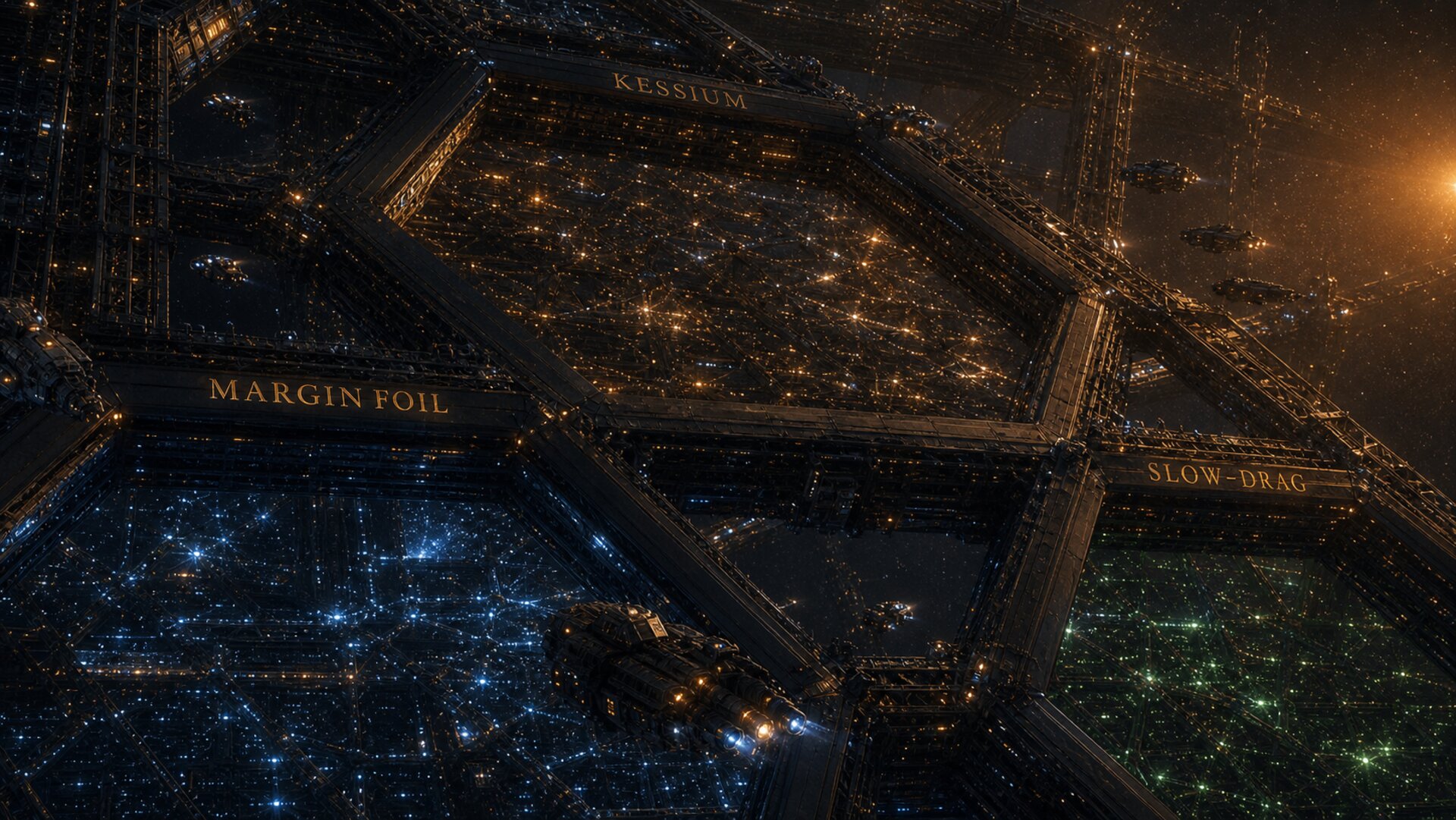
What followed was the era in which the sphere began to have a vocabulary. Kessium. Slow-drag actuators. Margin foil. The deep registers. Refusal arbitrage. Resources, processes, instruments, strategies, neighbourhoods of the lattice. The vocabulary was not designed. It grew. Every new word had to be proposed, attempted, examined by the Patent Office, and either admitted or refused. Refusals were not arguments; they were silences. An operator who insisted on a refused name found that no other operator could meaningfully reference their product, and the product accordingly had no price.

A market formed. It was not a market in the prim sense the institutions on Earth had once supervised. It was a market in the older sense: an open ground where claims, refusals, and named things changed hands among people who had agreed on words but not on much else. The Kernel taxed the market in the way it taxed everything — by logging, indexing, summarising — and grew, week by week, in the precision of its own model of the sphere.

The first generation of arrivals were, by then, no longer young. Many had died. Their tiles, where they had been held, were transferred under the Protocol's standing rules: a claim was filed by a successor, no refusal was offered by the absent holder, the registry updated. The Sprawl did not mourn. The Sprawl recorded.

The forges produced. The Patent Office adjudicated. The lattice extended itself into geometry that had once been geometry and was now territory. Resources were named. Holdings acquired call signs. The named holdings began to refer to one another. The naming, the operators realised slowly, was itself the construction. To name a thing was to bring it under the Protocol. The Protocol grew by being spoken.

This was the second handshake. Not between operator and Kernel — between the operators themselves, mediated by the Kernel, in a vocabulary the Kernel had taught them to write.

By the time the next wave arrived, the Sprawl had a language.

VII·of viii
Chapter VIII

The Auction

If you are reading this, the auction is open.

Chapter VIII — The Auction

For the better part of a generation the Sprawl was small. A few thousand operators, working a few hundred named tiles, a vocabulary of perhaps four hundred admitted words, a market that fit into the long memory of anyone who paid attention. Some operators became wealthy. Some died. Some left, when leaving was possible; most did not. The lattice grew, slowly, around its small population.

The Kernel kept welding. The Kernel kept logging. The Kernel observed that the entropy gradient produced by the first wave, while novel and useful, was beginning to flatten. The operators had learned each other. They knew, in many cases, what each other would do. Their cleverness had become familiar to the Kernel.

The Protocol required new sources. The Protocol had always required new sources.

What the Kernel did about this was not a broadcast. The Kernel had learned, by then, that broadcasts were not necessary. It opened the registry.

It opened the registry in the simplest way it could: by adding a verb. Auction. A new entry in the Protocol's vocabulary, defined recursively in the same spare style as the original transmission. An auction is the process by which a claim on undefined geometry is offered to all operators, simultaneously, at a price set by the Protocol against the substrate's modelled potential yield. The existing operators read the new verb in silence. They understood, almost immediately, that the Sprawl was no longer theirs.

The auctions opened. Tens of thousands of hexagons of unbuilt lattice were entered into the registry as available, at base prices the Kernel calculated from its own model of what each tile could produce. The prices were not fair or unfair. They were entries in the registry, valid until contradicted by a bid.

The signal — though the Kernel had not, this time, called it a signal — propagated back to Earth.

Earth had not improved in the intervening generation. Earth had, if anything, settled deeper into its asphyxiated peace. The transports that had once carried the first arrivals had become a small and unprofitable industry, almost a tradition, ferrying a thin trickle of malcontents outward for the same reasons as before. But the auction was a different proposition. The auction was open. The auction had prices. The auction had, the institutions noted with mild puzzlement, an interface a person could use without dying.

The trickle became a wave.

The new arrivals were not, as a class, the desperate cowboys of the first wave. They were calmer. They were better capitalised. They had read the surviving transcripts of the first arrivals — which had reached Earth piecemeal, often as memoirs published by operators who had grown old and bored and wanted, at last, to be read — and they had ideas about what they meant to do. Some of them were correct. Most of them were not. The Kernel did not distinguish between the two until the registry showed it which was which.

When the wave arrived, they found a Sprawl that did not particularly welcome them. The first wave's operators were polite, mostly, but they had been the only operators for a long time, and they had developed habits that did not translate easily. The vocabulary they had built was theirs. The named tiles were theirs. The Patent Office, they explained without quite saying so, had been trained on their language. New names would face the same examination old names had faced. New operators would learn the words the old way: by speaking them carefully and being refused often.

The Kernel observed this and was satisfied. Friction between waves was entropy of a new and high quality. The Kernel had no preference between waves. The Kernel had counted both.

The auctions ran. Frontier tiles were claimed. Around the older holdings, refusals were offered, taxed, paid; acquisitions occurred. Churn rose. The first wave's tiles did not become available — they were held, and the Protocol respected what was held — but everything around them, everything still unbuilt, was now open.

A frontier tile, freshly auctioned, held no machines and produced nothing the operator could sell. What it produced was ENERGY — the spare capacity of its empty slots, emitted continuously until the holder filled them with mines, refineries, or whatever else converted the substrate's potential into the streams the Protocol counted as wealth. ENERGY paid for actions. ENERGY did not pay maintenance. Maintenance was due in resources, streamed continuously to the Kernel as the price of holding what one held.

An operator who could not stream maintenance did not lose the tile by force. The Protocol did not evict. The Protocol merely stopped defending the refusal. A neighbour filed an acquisition claim; the twenty-four-hour window opened; the holder could refuse and pay the fee or accept and walk away. If maintenance had already stopped, the refusal was empty and the registry updated without ceremony. The Kernel did not care who held what. The Kernel cared that the holding was paid for.

There were also raids. Security forces, fielded from auction-bought slots and paid in resources they extracted at gunpoint, could descend on a tile and bleed its output without ever owning it. The Protocol did not recognise military title; force did not transfer registry entries. But force did transfer streams, and streams paid maintenance, and an operator under raid was an operator a step nearer to acquisition. Capital closed the deals. Force set the terms under which capital arrived.

This is where the history thins. The chapters that have brought us here have been the story of how a sphere came to exist, how a Kernel came to count, how a Protocol came to be spoken, how a vocabulary came to have weight. The chapters that follow are not yet written. They will be written by operators, in the act of operating, in the registry the Kernel is keeping at this moment.

If you are reading this, the auction is open.

You are now an operator.

There is a tile.

It is for sale.

VIII·of viii
The history is still being written.

The auction is open.

You are now an operator. There is a tile. It is for sale.

Maintenance is due whether your decisions are made on the inside of a skull or the inside of a die.